This study explores how various geometric features of UAV propellers—such as diameter, pitch, chord length, winglet modifications, surface finish, and icephobic coatings—affect ice accumulation, aiming to optimize propeller designs for minimal performance degradation in icy conditions and enhance the efficiency of UAV operations.
Key Research Insights
In-Depth Testing: A comprehensive series of experiments are being carried out to analyze the effects of different geometric and surface characteristics of FALCON propellers on ice build-up. The aspects being examined include:
Effect of propeller diameter
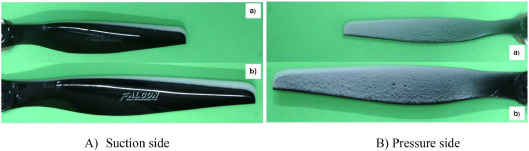
To investigate the effect of diameter of the propeller balde on RWUAV icing severity, experiments were performed using two identical propeller baldes with different diameters. The propellers considered are Falcon C2E11 x 06 and C2E15 x 06 having diameters of 11 inches and 15 inches respectively. Both these propellers have an identical pitch of 6 inches. Fig. 1 shows the suction and pressure sides of the iced propellers and the nature of the accreted ice is observed to be rime. The nature and shape of the accreted ice on both the propellers were observed to be same. The large surface area of the 15 x 06 propeller increases the droplet impingement areas, thus increasing the ice mass on the balde surface. The total mass of ice accreted after 300 s on the 15 x 06 blade is 4.5 g which is almost 2 times higher than the same on the 11 x 06 blade (2.3 g).
Effect of propeller pitch
To examine the impact of propeller blade pitch on icing severity, experiments were conducted using two identical propeller blades with different pitch values. The propellers used in this study are the Falcon hobby C2E16 × 03 and C2E16 × 12, both featuring a diameter of 16 inches, having a pitch value of 3 inches and 12 inches respectively. Fig. 2 illustrates the suction and pressure side images of the propellers with rime ice accretion. As observed for the diameter case, the overall shape and type of ice accreted is similar for both propellers. The higher pitch of the 16 × 12 propeller blade increases direct droplet impingement on the pressure side of the propeller blade, resulting in increased density of rime feathers on the pressure side relative to the 16 × 03 propeller blade. The total mass of ice accreted after 300 s on the 16 × 12 blade is 4.9 g, which is approximately 1.6 times greater than the 3.1 g observed on the 16 × 03 blade.
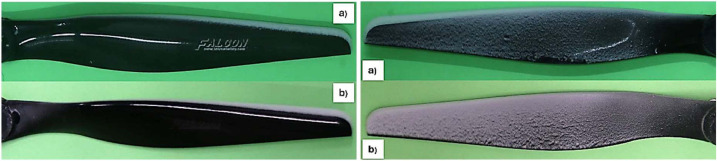
Fig. 2. Captured images of UAV propeller blade after 300 s of ice accretion-Effect of propeller Pitch at a) 16 × 03, b) 16 × 12.
Effect of propeller chord length
To study the influence of chord length of propeller blades on icing behavior of RWUAVs, icing tests were conducted on two geometrically similar propeller blades differing primarily in chord length. The blades being studied are the Falcon hobby C2E13 × 05P (narrow blade) and C2E13 × 05 W (wide blade). Both have a diameter of 13 inches and a pitch of 5° The variation in the chord length of the blade across the propeller span is shown in Fig. 3. illustrates the suction and pressure side images of the propellers with ice accretion, which shows rime ice characteristics. As observed for the diameter case, the increased surface area of the larger-chord propeller resulted in a greater collection surface area for ice accretion, thereby increasing the total accumulated ice mass. After 300 s of ice accretion, the 130 × 5 W blade gained a total mass of 3 g of ice, approximately 30 % more than the 2.3 g collected on the 13 × 05P blade.
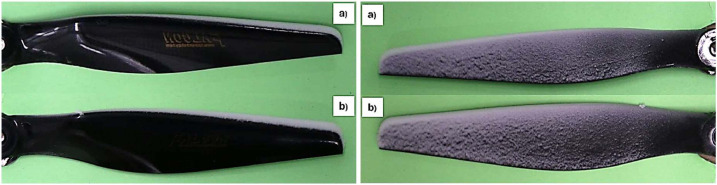
Fig. 3. Captured images of UAV propeller blade after 300 s of ice accretion- Effect of propeller chord length at a) 13 x05P, b) 13 x 05 W.
Effect of propeller winglets
To investigate the effect of propeller balde winglets on icing in RWUAV, icing tests were conducted using two analogous propeller blades featuring distinct tip configurations. The blades under examination are the Falcon PBB18 x 6 (without winglets) and PBE18 x 6 (with winglets). Both have a diameter of 18 inches and a pitch of 6.1 °. Fig. 4 shows the suction and pressure side views of the propellers with rime ice buildup. The ice morphology on either side of the propeller is comparable, the blade with winglets has a noticeable zone between the leading edge and trailing edge where there seems to be less ice accumulated. After 300 s of ice accumulation, the ice mass on the blade without winglets was 4 g, while the blade with winglets had an ice mass of 3.9 g.
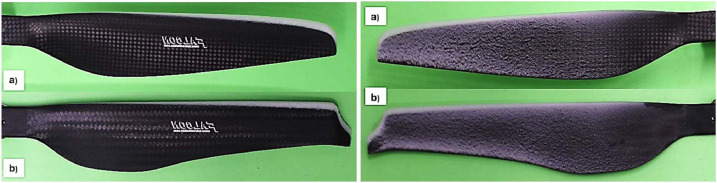
Fig. 4. Captured images of UAV propeller balde after 300 s of ice accretion-Effect of propeller winglets at a ) without winglets, b) with winglets.
Effect of blade surface finish
To examine the effect of propeller blade surface finish on icing in RWUAVs, tests were performed using two similar propeller baldes with differing surface finish properties. The average RMS height of the surface roughness elements for the matte finish blade is 1.21μm and that for gloss finisg blade is 0.16μm. For these tests, icing duration was extended to 1200 s or for the first point of ice shedding. The blades being analyzed are the Falcon PBB18 x 6(matte surface finish) and PAW18 x 6(gloss surface finish). Both have a diameter of 18 inches and a pitch of 6.1°. Fig. 5 illustrates the captured images during the ice accretion process using the high-speed imaging technique for both the propellers. The camera was positioned above the transparent test section and focused on the suction side of the propeller blade. Ice shedding is observed on the gloss surface finish propeller after 900 s of ice accretion. For the matte surface blade, no ice shedding is observed until 1200 s of icing.
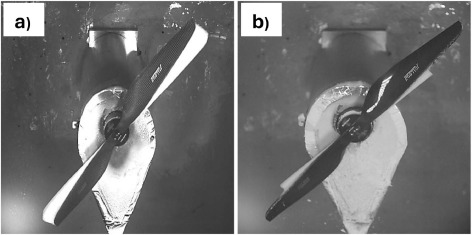
Fig.5. Captured images of the UAV propeller blades using high speed imaging technique after 900 s of icing - Effect of propeller surface roughness a) matte surface finish, b) gloss surface finish after ice shedding.
Effect of icephobic coatings
In order to examine the influence of icephobic coatings on UAV propeller icing, experiments were performed on two similar propeller baldes with and without icephobic coating. The propeller blade utilized is the Falcon PBB18 x 6(matte finish blade), and an ice-phobic coating is applied to the blade's surface. The application of icephobic coating has increased the surface roughness of the blade surface to 7.22 μm. The blade has a diameter of 18 inches and a pitch of 6.1 inches. Fig. 6. illustrates the images obtained during the rime ice accretion process utilizing high-speed imaging techniques for both propellers. Ice shedding occurs on the propeller blade with ice-phobic coatings following 488 s of ice accretion. No ice shedding is observed on the matte surface blade until 1200 s of icing.
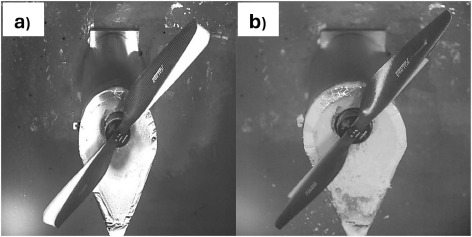
Fig. 6. Captured images of ice accreted UAV propeller blade using high speed imaging technique-Effect of icephobic coatings a) matte surface finish (1200 s), b) ice phobic coating (488 s).
The study mainly presented the variation in thrust decline rates and input electrical power consumptions associated with ice accretion on propeller with various propeller geometric parameters. However, the maximum thrust savings observed between two compared propellers does not exceed 5%. On the other hand, the savings in power consumption are >20%. An incremental improvement in propeller geometric characteristics can lead to a significant reduction in the power required for flight, which is essential for increasing range and endurance. The smaller diameter propeller seems more tolerant to icing at a given rotating speed. The T/P ratio of the larger blades degrades significantly with ice accretion. The input electrical power consumption due to icing almost doubled when the chord length increases to nearly 15%. The propeller winglets appear to provide minimal advantages in mitigating icing severity. The alteration in surface characteristics significantly influences ice shedding behaviour. The change in surface roughness (matte to gloss) can cause ice shedding after 900 s of icing, the application of icephobic coatings has led to earlier shedding at 488 s, while the ice on the matte propellers does not shed even after 1200 s of ice accretion. The severity of icing is thus diminished with propellers that have a smaller diameter, lower pitch, shorter chord length, smooth surface finish, and have an icephobic coating on its surface.
The results suggest that geometric optimization may offer a passive means to reduce severity of performance degradation during icing and, consequently, lower the power requirements of active ice mitigation systems. However, this study should not be viewed as a comprehensive analysis, but rather as an exploratory one. A more complete understanding will required broader investigations spanning a wider range of operating conditions, multiple propeller blade designs, and, tests on full UAV platforms. Complementary numerical simulations could also help explore additional design variations and icing scenarios more efficiently. Nonetheless, the study emphasizes the potential of employing improved propeller geometry to reduce performance degradations due to icing.
Based on the research findings, FALCON will explore improving propeller geometry in the future to reduce performance degradation caused by icing, thus facilitating our innovation and development efforts.
